
The 15-Month Wait-Out Period Has Been Removed: What Does This Mean for Private Property Right-Sizers?
- Ethan Hariyono
- 5 min read
- Blog
- 3 Aug 2026

What Exactly Has Changed?
In May 2025, Minister for National Development Chee Hong Tat said the Government could review or remove the 15-month wait-out period once HDB resale prices began to moderate.
A year later, the measure has been removed with immediate effect. Eligible private residential property owners and former owners can now purchase a non-subsidised HDB resale flat without serving the wait-out period, provided they do not take an HDB housing loan.
Table 1: Changes to the 15-month wait-out period imposed on private property owners (PPOs) and ex-private property owners (ex-PPOs) with effect from 28 July 2026
| Situation | Previous requirement | Requirement following removal |
| Buying an eligible non-subsidised HDB resale flat without an HDB housing loan | 15-month wait-out period after disposing of private property | No 15-month wait-out period |
| Existing private property owner purchasing an eligible resale flat | Generally had to dispose of the private property and complete the wait-out period first | May proceed with the eligible resale purchase, subject to prevailing conditions |
| Disposal of existing private residential property | Before serving the wait-out period | Within six months after completing the HDB resale purchase |
| Buying a subsidised flat, resale flat with housing grants, new EC or using an HDB housing loan | 30-month wait-out period | No change; 30-month requirement remains |
Source: HDB, MND, ERA Research and Market Intelligence
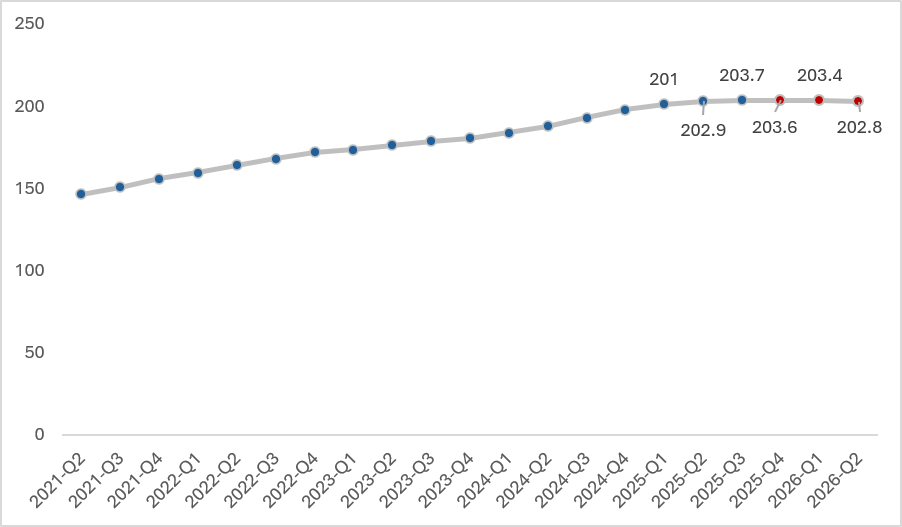
The decision follows clearer signs of market moderation. After five quarters of slower or no growth, the HDB Resale Price Index (RPI) declined by 0.1% in 1Q 2026 and a further 0.3% in 2Q 2026. With more flats also expected to reach their Minimum Occupation Period over the next few years, the resale market is better positioned to accommodate additional demand.
Chart 1: The HDB Resale Price Index (RPI) has declined for consecutive quarters in 2026
What could the policy change mean for private property right-sizers, HDB resale buyers and the wider housing market? Below, we examine its potential impact.
From Cooling Measure to Policy Recalibration
The 15-month wait-out period was introduced in September 2022 as a temporary measure aimed at cooling demand from private homeowners entering the HDB resale market during a period of strong price growth.
At that time, private homeowners typically had greater purchasing power stemming from capital gains or proceeds from selling their existing properties, which resulted in intensified competition for resale HDB flats. By requiring a waiting period, the policy sought to prioritise access for buyers with more immediate housing needs and to reduce upward pressure on prices, particularly for first-time homebuyers who chose to enter the resale market rather than go down the BTO route.
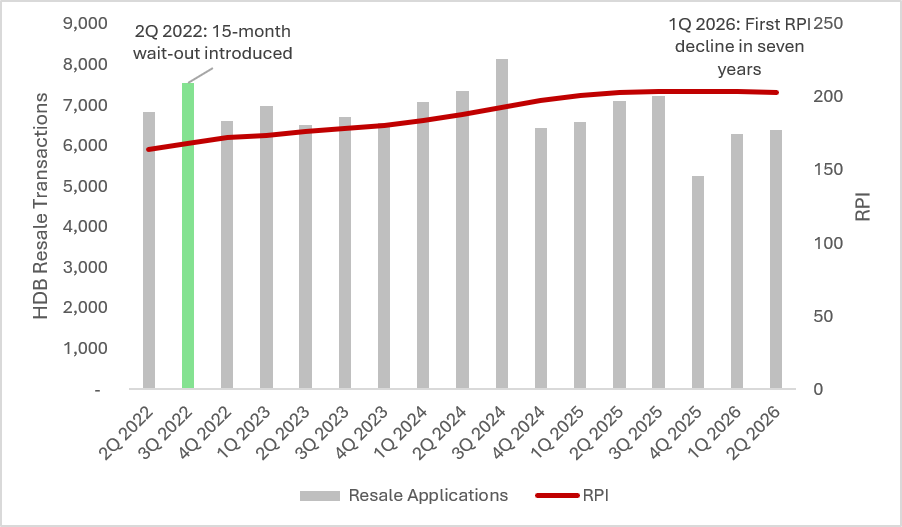
ERA’s earlier analysis found that the measure did have an initial moderating effect on both transaction volumes and price growth for HDB flats. However, this impact gradually weakened as affected households completed their wait-out periods, with market activity and prices recovering thereafter.
Chart 2: HDB Resale Transactions vs Resale Price Index (RPI)
What Does the Change Mean for Private Property Right-Sizers?
The removal of the wait-out period gives eligible private homeowners a more direct pathway into the HDB resale market. Essentially, the change grants them a much greater degree of freedom, especially for PPOs that might be waiting for an opportune time to make their rightsizing move. Previously, they generally had to sell their private property, arrange interim accommodation and wait 15 months before purchasing a non-subsidised resale flat.
Eligible private residential property owners can now purchase such a flat without serving the wait-out period, provided they do not take an HDB housing loan. They must first obtain an HDB Flat Eligibility letter and dispose of their private residential properties in Singapore and overseas within six months after completing the HDB resale purchase.
The change may benefit retirees, empty nesters and other households looking to unlock housing equity, reduce debt, increase their retirement funds or move closer to family and essential amenities. However, right-sizing does not necessarily mean choosing the smallest or least expensive flat. Many households may continue to prioritise sufficient space, accessibility and proximity to familiar neighbourhoods.
Careful planning remains necessary. Owners will need to coordinate their private property sale, HFE application, financing and HDB completion while accounting for outstanding loans, CPF refunds, renovation expenses and the funds they intend to retain for retirement. The removal of the wait-out period creates flexibility, but households should still select a home that remains financially and practically suitable over the longer term.
Unlocking Greater Mobility Across Singapore’s Property Landscape
The change should unlock some pent-up demand, and the effects will hit the HDB resale market over time, particularly for larger, newer and well-located resale flats. Private homeowners may favour homes that offer a relatively seamless transition from private housing in terms of space, accessibility and surrounding amenities.
This might translate to an increase in million-dollar flat transactions, especially for flats that are newer and larger flats that are located in aforementioned mature estates or central locations. However, this demand is likely to be met d due to an increased supply pipeline of MOP flats in the coming years.
Together with the continued supply of BTO flats, this should help the market absorb anticipated incremental demand and maintain a reasonable balance between buyers and sellers.
I confirm that I have read theprivacy policy and allow my information to be shared with this agent who may contact me later.
